Shortly after his family arrived in the United States from China, Richard Yen ’53 had acceptances from three universities. He chose Brown, partly because his father felt strongly that Brown was the right place for his son.
“My father wanted me to go to an Ivy League school,” says Yen. “He went to Columbia, and he knew that at Brown I would have better contact with professors because of its smaller size.”
His Brown scholarship covered tuition, but he worked on campus as a dining hall server and off campus as a draftsman at a small architectural firm to cover his room and board. Still, he found time to become a member of the Brown Engineering Society, the American Institute of Electrical Engineers, and the Brown Chapter of the Institute of Radio Engineers.
“At Brown, I had to work very hard,” he says. “I learned that no matter how intelligent a person is, you have to work hard.”
In 2021, Yen and his wife Fukan decided to support Brown’s efforts to launch need-blind admission for international students. They established the Richard H. and Fukan T. Yen Scholarship, helping to ensure that Brown can continue to enroll the brightest students from a broader range of socioeconomic backgrounds from around the world.
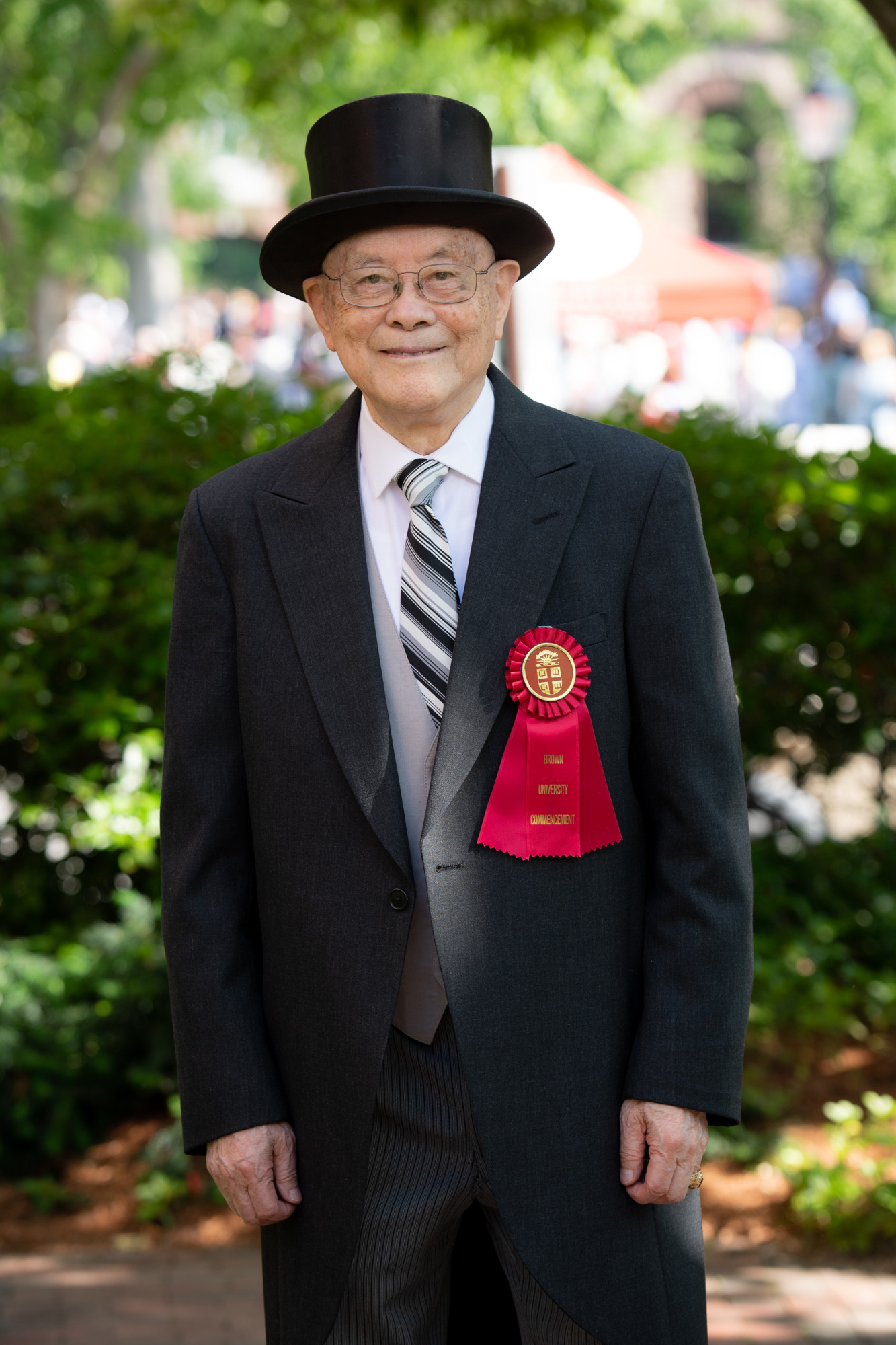
Through their philanthropy, they hope today’s Brown students are able to balance their hard work with the joy of their journey, so that the next generation of international students do not have to choose between their studies and their well-being.
“The most important reason for me to support students who have financial difficulties is because of my own life experience,” says Yen. “I don’t want to see any student working every minute of the day without any relaxation, like I did. Although I learned a good lesson—that success requires hard work—enjoying life is equally important in one’s life growing up.”
By alleviating the burden of “working every minute,” Yen is gifting students something he rarely had: the time to simply be a student.
To date, the Yens’ scholarship has been awarded nine times to seven different students from Shanghai, Taiwan, California, and New York. The students’ concentrations have ranged from economics, engineering, and English to biochemistry, computational biology, geophysics, and molecular biology.