Alums back at Brown for AI leadership roles
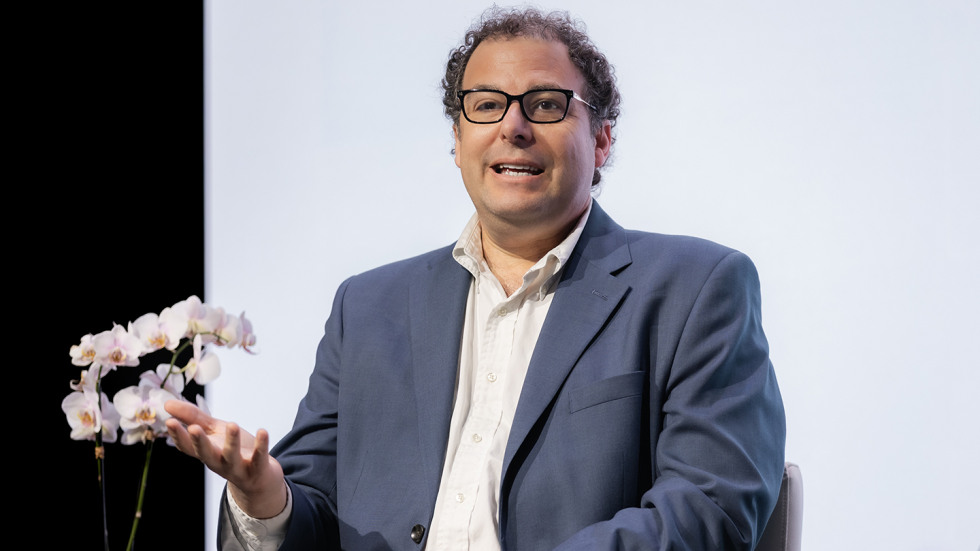
Littman may be Brown’s first Associate Provost for Artificial Intelligence, but his connection to AI at Brown goes back much further.
“Brown has been engaged in artificial intelligence work for a really long time,” said Littman. “In fact, I got my Ph.D. at Brown in artificial intelligence, graduating in 1996. And I wasn't the first. There was a lot of work going on that was really, really interesting.”
Littman began teaching in Brown’s computer science department in 2012, before leaving for a few years to focus on AI within the federal government. He returned to Brown in 2025 to take on this new leadership role.
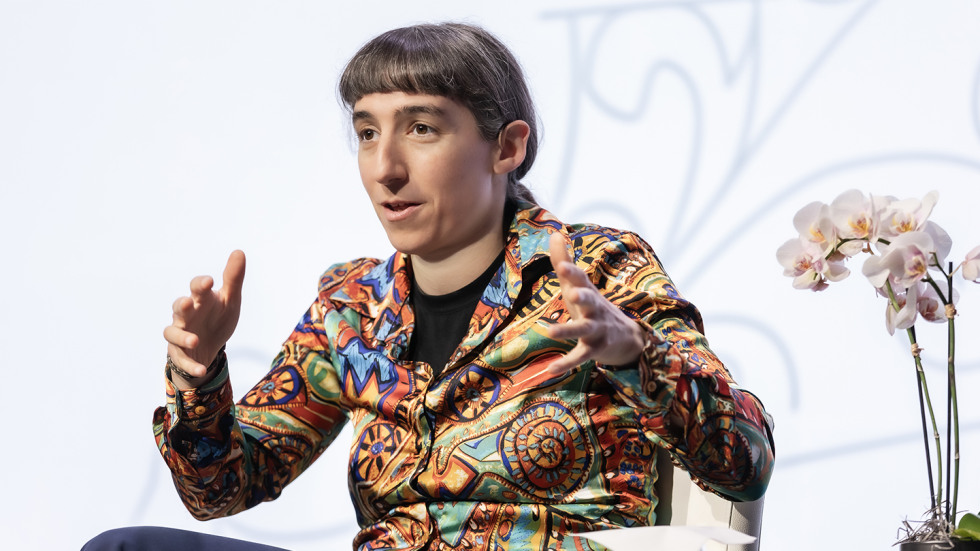
Rubenstein graduated from Brown as a chemical physicist with an applied math background, and returned to College Hill about a decade ago. Now, leading the Data Science Institute, her aim is to help people across the campus community access and understand data, including through analysis of AI and machine learning.
“I came back to Brown because it was an incredible experience to think across a wide variety of different disciplines,” said Rubenstein. “I very specifically decided to attend Brown—perhaps as many of you did as students—because I was interested in crossing the social sciences with a lot of the hard sciences.”
Brown’s collaborative approach to exploring AI’s impact on research
During the panel, Littman and Rubenstein discussed ways that AI has revolutionized health and science research, as well as how Brown’s collaborative culture makes it a uniquely effective place for exploring AI.
Rubenstein described how AI allows researchers to accelerate computational science and test hypotheses much more quickly, potentially shaving years off of research projects.
“What AI really lets us do is not only think of ideas, but actually get a first test,” explained Rubenstein. “It might not be the most accurate thing. It might not tell you the answer for everything. But it really lets you say: Here's a hypothesis, would it actually make any sense to put it in the wild?”
She went on to specifically dive into how AI is supporting RNA researchers at Brown. “We're amassing huge amounts of RNA data. It's all dedicated to understanding the structural properties of RNA. And so that's an area where AI can really go in and tell us things that we never understood before.”
As AI reframes how researchers approach difficult questions about science, Littman sees Brown’s interdisciplinary academic style as a unique strength in this pursuit.
“Brown uniquely excels at collaboration across boundaries," he said. “The attitude on campus is: Let's come together to think about global issues in new ways. And I think that's extremely critical in this AI era—partly because, now that AI is everywhere, the way to make progress, the way to actually do things that are important, is to reach across and make these connections. And I think Brown is really well-situated for that.”
Rubenstein provided a specific example of Brown’s cross-campus collaboration. She explained that the deputy director at the Data Science Institute is Holly Case, a professor of history.
“If you go to other institutions, they'd probably be like, ‘no way, we're never having a historian be a deputy director of data science, why does that even make sense?’” said Rubenstein. “But Holly's our deputy director because she brings in the knowledge of humanistic thought—thinking about how AI would actually impact the course of history.”