The arts and humanities—essential to the Brown experience
Dean of Faculty Leah VanWey explains how Brown’s culture of collaboration, the Open Curriculum, and a world-class faculty combine to give students the critical thinking skills and confidence to “balance the speed of technological innovation” while navigating complex global challenges.
Leah VanWey, Dean of the Faculty, Professor of Environment and Society and Sociology
As higher education navigates rapid technological innovation and a changing global landscape, Brown is leaning into and investing in its liberal arts mission.
From bridging theory and practice to examining the ethical frontiers of artificial intelligence, this wide-ranging interview with Dean VanWey highlights how Brown’s interdisciplinary environment prepares students not just to seek quick answers, but to learn the process of critical thinking, “sit with ambiguity,” and engage meaningfully with today's world.
You’ve been at Brown for nearly 20 years, serving as Dean of Faculty for the last four years. What fundamental changes in the arts and humanities have you observed?
Brown has this amazing combination of what we traditionally think of as the humanities—curiosity-driven scholarship about the history and culture of a particular area, or an artwork, or a book. And we pair it with a sense of impact on the world and how we speak to today's questions and the needs of today's students in today's world.
When I think about changes in our humanities fields, the first trend that I see is a movement to be much more global. The humanities have traditionally been very Eurocentric, coming out of a great books tradition and classical knowledge.
Another important trend within the humanities is thinking about and deeply engaging with emerging interdisciplinary humanistic fields that have present-day relevance. Within the Cogut Institute for the Humanities, the Center for Environmental Humanities engages with the important questions about what it means to be human in a world in which technology is changing rapidly and environmental change is a pressing concern.
Turning to the arts, I’d say the most important trend is what the practitioners in our fields refer to as the integration of theory and practice. Historically, there were arts criticism departments that analyzed artwork and studied the process of creating a work of art, and art departments that offered studio courses and focused on practice of visual and performance art.
Our arts departments have moved towards this integration of making art and theorizing about artworks. Across arts fields, we have this integrative way of doing the work and then writing about the work, and that really gives faculty and students the ability to see exciting things about theory when they're actually doing the practice.
And this has intersected with the structural changes of the University, with the Brown Arts Institute and other centers that cross between the arts and humanities. At the institutional level, that creates the infrastructure that lets faculty do more than just teach.
And what’s distinctive about Brown’s approach to teaching and research that sets us apart from peer institutions?
I would point to how Brown’s integrative approach to the arts and humanities creates the spaces where exciting and interdisciplinary conversations can happen and innovative creative practices can occur organically.
And when I say integrative, I mean that we are engaging undergraduate students, graduate students, faculty, curators from our archives, and faculty from other universities to come together to do work on really exciting topics. And so we're integrating across these different groups of people, across different disciplines and different research areas and at a variety of career stages.
We are also integrating the research and artistic practice with teaching. On the day-to-day level, you can see that in the curriculum, as we have far fewer survey courses. What we have at Brown are small-sized courses that are really focused and integrate the students into the research of the faculty, and into the research that's being done in our archives and in our museums. This lets the students see how the sausage gets made in terms of the creation of artwork and the creation of humanistic scholarship.
“ In today's world, especially with AI, there's so much focus on getting an answer as opposed to the process of learning and the process of thinking. In our arts and humanities courses, there are no shortcuts to get to the answer because it’s not about the answer. The process and the thinking is the outcome.
”
Leah VanWey
Dean of Faculty
What can students learn through the arts and humanities that will help them understand the world today and provide them with the critical thinking skills and tools to create a better future?
In today's world, especially with AI, there's so much focus on getting an answer as opposed to the process of learning and the process of thinking. In our arts and humanities courses, there are no shortcuts to get to the answer because it’s not about the answer. The process and the thinking is the outcome.
Students get the full range of the process from figuring out what an interesting question is, to looking at documents that are relevant and understanding what other people have said about the topic, and making their own argument. This is how they create their own argument, and they train in the process of thinking through research, thinking through writing, and then thinking through either verbal or written argumentation and critical engagement with their peers.
This ties back to the principles of the Open Curriculum. The important thing that happens at Brown is the discovery of knowledge in a community and in collaboration with the staff, faculty, and students around you. And so the relationships that students make are not just about networking, but about learning how to think together. It's not just a team-based project where you're coming up with the right answer. It is a team-based project where students learn to have an ongoing relationship and ongoing conversation over multiple months with their fellow students. And the small size of our arts and humanities classes allows faculty to mentor students in the development of those relationships.
In terms of research, we have a working group in Cogut on disability studies. Whereas disability studies in most schools is very much focused on the present day, Brown’s group is studying disability in the ancient world. They're questioning how disability has been thought about during different periods in history and how that plays out in art, athletics, and history.
Thinking about distinctive approaches to the creative practice, our non-fiction writing program includes workshops on personal medical narratives and climate anxiety led by Kate Schapira MFA'06, an associate teaching professor of English. These courses focus on understanding how changes in the world relate to changes in the student’s own lived experience.
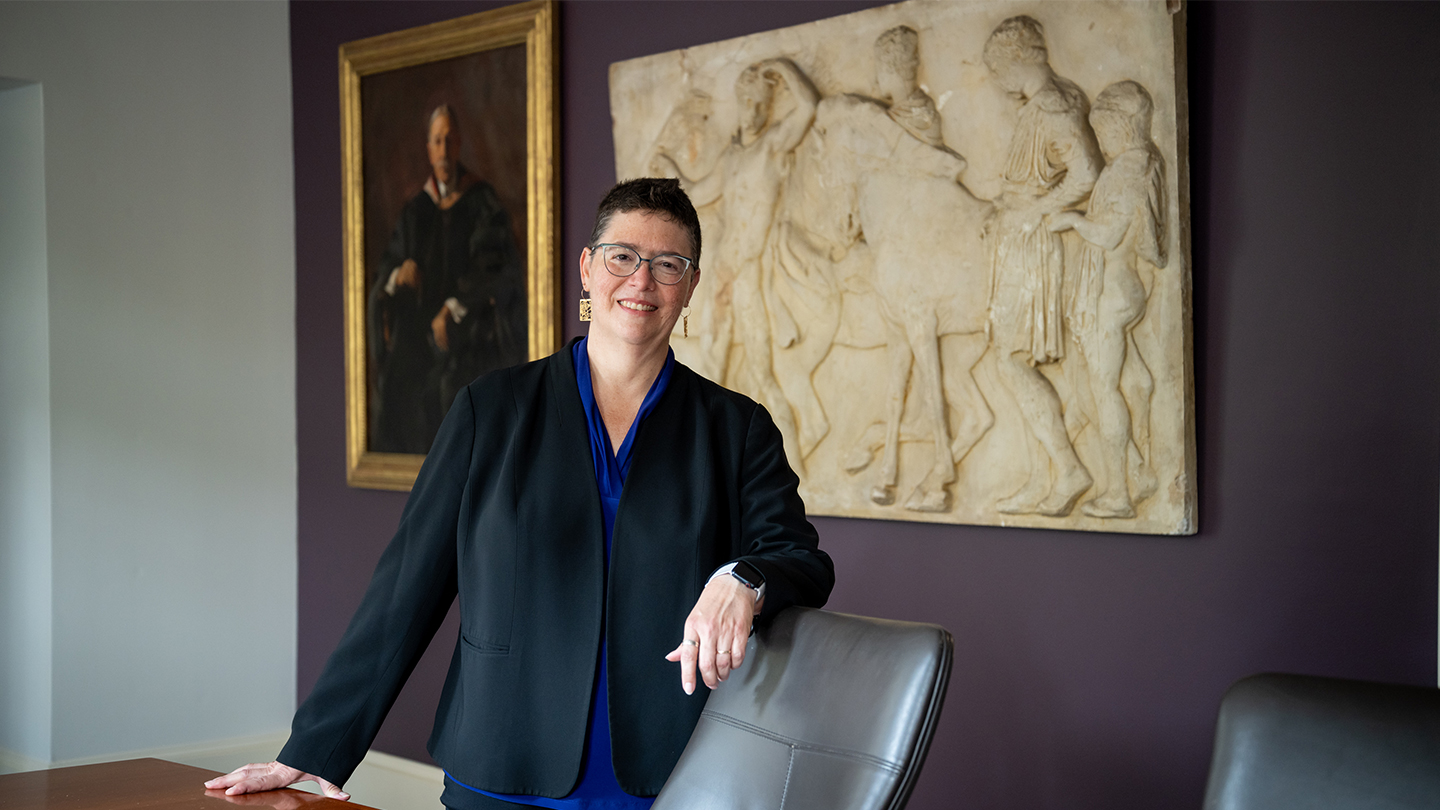
Dean VanWey in the Horace Mann House, home to the Department of Classics.
How would you characterize the role the humanities play in understanding the power of artificial intelligence and its responsible use?
The humanities are always providing us ways of answering—not the answer—but ways of answering the question about what is the appropriate, ethical way to behave in a particular situation. I would say that many of our humanities classes, by focusing on history, context, relationships between different communities and people, are helping students not just make an ethical decision about how to use a particular piece of technology in a specific situation but are helping us understand the way in which technology interacts with our communities.
One of the challenges with AI is understanding what it means to be human, and what it means to use technology; what it means to interact with technology, and what it means to interact with a human versus interacting with an AI agent that could appear human. The heart of humanistic study is the continual questioning of what it means to be human.
One of the things that I love about Brown is our focus on positive impacts in our local community and in the larger world. A lot of that is imbued in many of our humanities classes. Those classes help students think about the role of technology, including AI, but also other technologies in changing the health of a community, changing income inequality, changing how well the community is functioning.
It is the arts and humanities that give us a way of short circuiting that rush to the answer and help us sit with ambiguity and sit with the process. And that will always balance the speed of technological innovation to improve things with the slowness that's necessary for people to think together about the impact of that technology.
Brown is known for its collaborative ethos. What are some ways that you see arts and humanities faculty and students collaborating with other departments?
Sam Birch, a planetary scientist in the Department of Earth, Environmental and Planetary Sciences (DEEPS), is teaching a course with a staff member from the Brown Arts Institute. Students are learning about current space exploration while also creating original works of art to represent that exploration. It gives students a way to apply ideas and information from one area and to express or show those ideas through creative skills and techniques developed in their arts practice.
The first “lab” at the Cogut Institute is co-led by Holly Case and Suresh Venkatasubramanian. This wide and varied set of activities brings together students and faculty across fields to study how to situate AI in a history of transformative technologies, and the connections between AI models of intelligence and other models across scientific and humanistic fields.
A more traditional example is a reading group of faculty, graduate students, and undergraduates who get together to read classical Chinese literature and analyze it from a literary, religious, and historical perspective. This group integrates across the communities on campus and across many disciplines that study pre-modern China.
The Cogut Institute for the Humanities has had such an impact at Brown since its founding in 2003. What’s happening at Cogut now that everybody should know about?
Across many of our humanities fields, faculty are thinking about how the academic world engages with the public and how we share the knowledge that we have with the public and also process feedback from the public.
Cogut’s initiative on the Origins and Afterlives of Ethnic Studies is directly engaging those questions, because interdisciplinary ethnic studies as a field or fields—Black studies, American Indian studies, Asian American Studies—all came out of the civil rights movement in the second half of the 20th century, as ways of engaging with the world, engaging with the public, and having a dialogue between academic knowledge and public impact in the world.
Models-Scale-Context: The AI and the Humanities Lab is the inaugural humanities lab within the Cogut Institute. This is a new model for the humanities. Historically, humanities fields are very monastic. You have an individual scholar sitting in a room, reading books and writing. But Cogut inspires scholars to be collaborative and to work together. The humanities labs are explicitly integrative, in the sense that multiple faculty leaders from different fields integrate postdocs, graduate students, and undergraduates into their research.
It is the opposite of a scientific lab in that they are not trying to discover the answer to a specific question. They are trying to figure out what all the questions are and all of the ways in which AI can and should intersect with the humanities.
And what’s new at the Brown Arts Institute? In what ways has it grown and evolved in its first five years?
The Brown Arts Institute (BAI) has experimented with a variety of different ways of engaging our community in appreciation of the artistic practice. What we're doing now is focused on providing intentional opportunities for students to create and perform and produce and curate world-class artistic practice and to interact with world-class artists.
These opportunities are scaffolded at multiple levels, from casual low-cost-of-entry activities to professional-level projects for people who are arts concentrators. There are 30-minute drop-in artistic activities in between classes, as well as opportunities for individual students or student groups to submit proposals to stage performances or gallery shows in some of the amazing spaces in The Lindemann Performing Arts Center, the Granoff Center for the Creative Arts, Bell Gallery, or the Cohen Gallery.
We've developed a number of structured ways for students to engage in a curriculum of courses that could not be offered in departments, including courses on careers in arts and nonprofits. In the BAI’s ongoing Ruckus Sessions, artists, researchers, and cultural leaders visit for a short period of time. In this way students can have that direct exposure to the work that the artist has produced or the research that they have conducted, and be part of a conversation on the creative practice.
And this all goes to our overarching goal for every Brown student to have an artistic, creative experience before they graduate.
Can you talk about how the Pembroke Center for Teaching and Research on Women sparks connection and collaboration among faculty, students, and staff?
The work of the Pembroke Center helps us all understand changes in society through understanding how those changes affect men and women differently. This scholarship ranges from archaeology and anthropology that looks at agency of women and other groups in the ancient world to studying the historical creativity and resilience of queer communities.
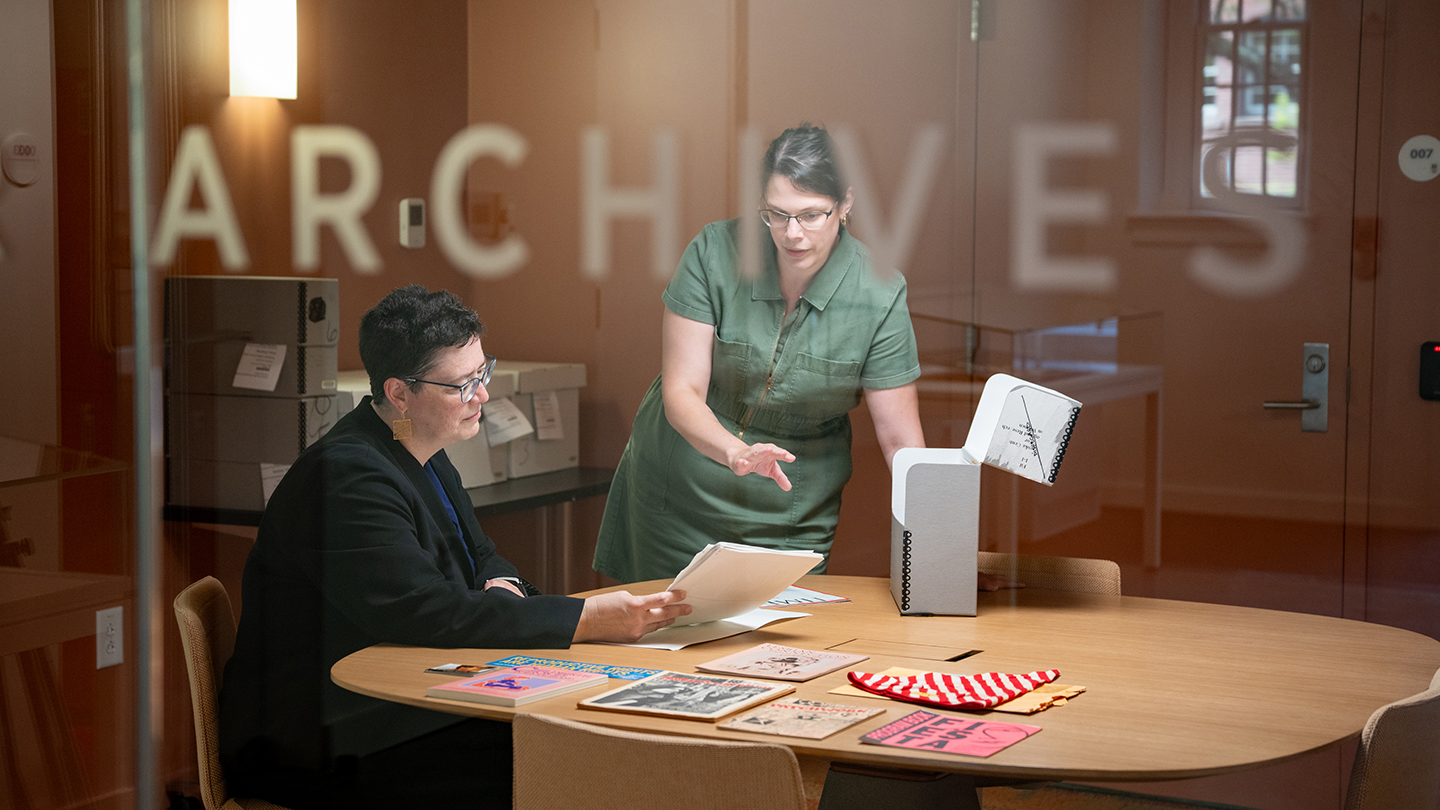
The Pembroke Archives holds a variety of materials on important Pembroke and Brown women and other important feminist leaders. And with the renovation of Pembroke Hall, those archives are fully accessible now for use in teaching and student projects. Multiple times every semester, the archivist will visit classrooms with materials to show students how the archive can be used and how students can see this history themselves and ask questions of the history.
Another great example of how Pembroke integrates archival work and teaching is through its signature Pembroke Seminar, which brings in scholars from other schools. Every year there's a different topic of focus. This past year, in line with the 250th anniversary of the United States, a political theorist is leading a seminar on: Memorialization and Monuments.
One of the most significant aspects of the renovation of Pembroke Hall, completed in fall 2025, was the creation of an upgraded space to store and study the renowned Pembroke Archives. Prior to the renovation, the archives for the Pembroke Center for Teaching and Research on Women were housed in Alumnae Hall.
The Brown Annual Fund launched the Humanities Fund last year and more than $458,000 was donated by alumni, parents, and friends. What are some projects or initiatives on the horizon that will be supported by this fund?
What an amazing level of support for the Humanities Fund in its launch year!
These donor-provided funds will be dispersed directly to academic departments. As we've grown institutes and centers in the humanities, much of the flexible funding to do creative and innovative work has gone to those priorities. So this support gives us a way to invest in many of our core humanities departments to allow them to advance curiosity-driven scholarship and community engagement in impact-focused activities.
I expect the funds will be used by each department for a range of programs to connect students and faculty to cutting edge scholarship, including student travel to national conferences, research travel to examine artifacts, artworks, and documents. Some departments might purchase materials for their research to add to university collections. Funding could also be used by departments to convene conferences that will bring multiple scholars to Brown.
What are some of the top funding priorities in the arts and humanities that would make a great impact on the student experience at Brown?
People and programs are top priorities, particularly professorships, postdocs, and graduate students. As all of higher education is facing budget challenges due to inflation and shifts in federal funding, Brown is leaning into the liberal arts at a time when other universities are pulling away. It’s truly an opportunity for Brown to invest in hiring the very best talent in important humanistic subject areas and in the arts that are not being supported anywhere else.
And we always need to invest in our academic programs. This is especially true in the arts and humanities. We see it as funding to create the structures and opportunities for academic innovation across multiple departments and across campus. These investments pay dividends in the undergraduate student experience and in the field-leading scholarship produced by our faculty.
Students come to College Hill from so many different backgrounds, and we need to be able to continue to train them how to think, how to write, how to read critically, and how to interact with each other. That requires a low student-to-faculty ratio for smaller class sizes, and it requires investment in interesting curricular and co-curricular experiences.
Support the humanities at Brown
With a gift to the Humanities Fund, you can help elevate creative programming that promotes an active dialogue on the most challenging questions facing today’s humanities scholars.
Moved by the support of the University’s athletics community during her time on College Hill, the former women’s track and field competitor is stepping up through volunteering so future Bears can have the same opportunities.
Through the generosity of The Starr Foundation, which is chaired by alumnus Jeffrey W. Greenberg ’73, Brown University and Brown University Health are partnering to advance treatment for age-associated diseases and extend healthy lifespan.